Dolfan Radio | Field Guide
By Brad Michaels • July 11, 2026
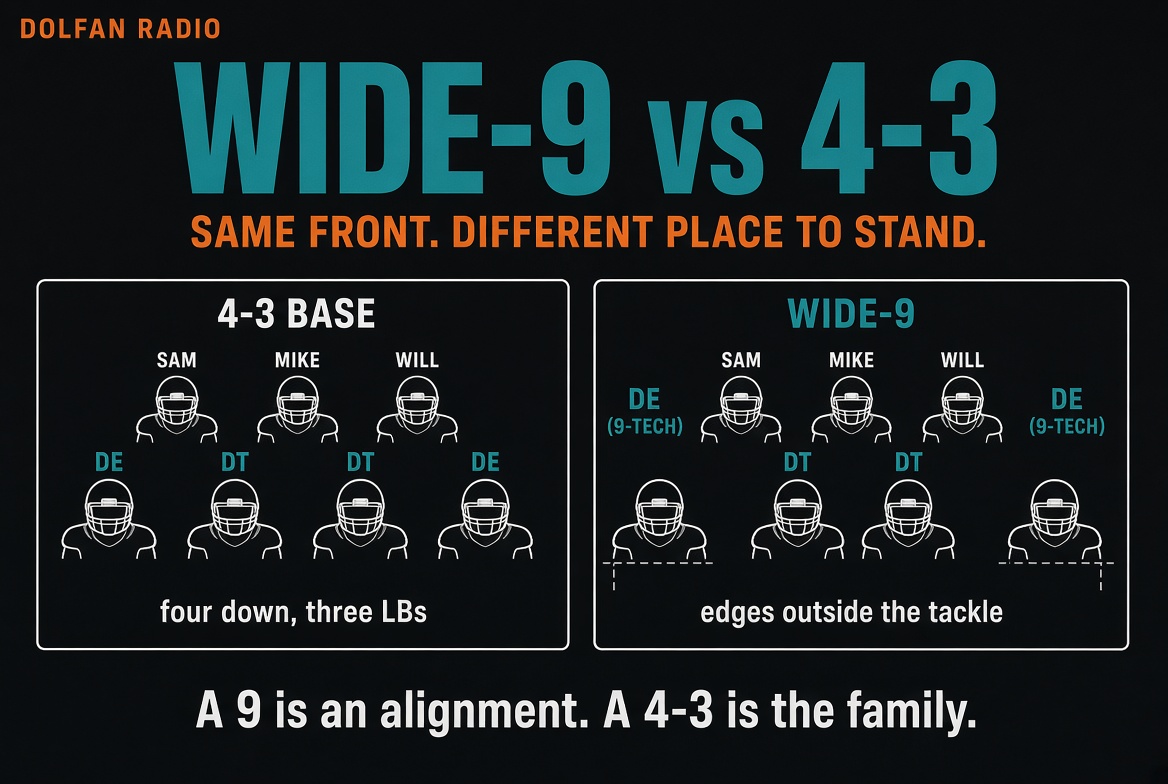
People hear Wide-9 and think Hafley installed a new defense. He did not. He installed a 4-3 and then told the ends where to put their feet. The family is the 4-3. The 9 is an address.
I have watched this argument in comment sections for twenty years. Somebody says 4-3. Somebody else says Wide-9 like it is a different sport. Then somebody brings up a 3-4 and the thread is dead. Here is the short version, because Sunday in Las Vegas is not going to pause so we can draw it on a napkin.
Four down linemen. Three linebackers — SAM, MIKE, WILL. That is the base Hafley said he would live in. The last two Miami staffs dressed like a 3-4. This one does not.
Same four down. The ends line up outside the offensive tackles — 9-technique. Cleaner rush angle. The run is supposed to bounce inside, where the linebackers are waiting.
A 4-3 tells you how many people have their hand in the dirt and how many are standing up behind them. A technique number tells you where those people stand on that snap. You can play a 4-3 with the ends tight on the tackles. You can play the same 4-3 with the ends walked out so far they look lonely. That second picture is Wide-9.
It is not a 3-4. A 3-4 puts three linemen down and four linebackers behind them. Hafley already told you he likes 3-4 structures out of the same 4-3 group so he does not have to sub. That is front variation. That is not “we became a 3-4.” If you want the longer version of that sentence, it is in the scheme piece from July 7.
| 4-3 base | Wide-9 look | |
|---|---|---|
| Down linemen | Four. DE-DT-DT-DE. | Still four. Same people. |
| Linebackers | SAM, MIKE, WILL | Same three. Fits change. |
| Where the ends stand | On or near the tackle | Outside the tackle. 9-tech. |
| What it asks the edge to do | Set a normal edge and rush | Set a wide edge and still get home |
| What it asks the LBs to do | Normal fits | The ball should come inside. Be there. |
Wide-9 only works if the end can do two jobs that do not like each other. Rush from a wide angle, and still set the edge so a stretch play does not walk to the numbers. If the end loses containment, the pretty drawing is a footrace and you lose.
That is why Chop Robinson is not a sidebar. Year 3. The scheme assumes an edge who can rush and set. Miami has not had that player on a full snap count in a while. Uche is light for the job. The rest of the room is a rotation until it is not. Sieler can eat blocks inside. He cannot play nine-technique.
The linebackers are the other half. Brooks and Rodriguez have to trust that the bounce is coming to them. If they step the wrong way because they do not believe the edge, you will see grass and a running back and a long afternoon.
I am not going to pretend this is a new religion. It is a place to stand. Hafley will mix it. Some snaps the ends will be tighter. Some snaps they will be out there looking like they are waiting for a cab. The family is still a 4-3. The question on Sunday is whether Chop and whoever is opposite him can live at that address for four quarters.
If that still feels like vocabulary, leave the question in the comments. I would rather explain it twice than watch us argue 4-3 versus Wide-9 like they are two different teams.