Dolfan Radio | Field Guide
By Brad Michaels • August 31, 2026
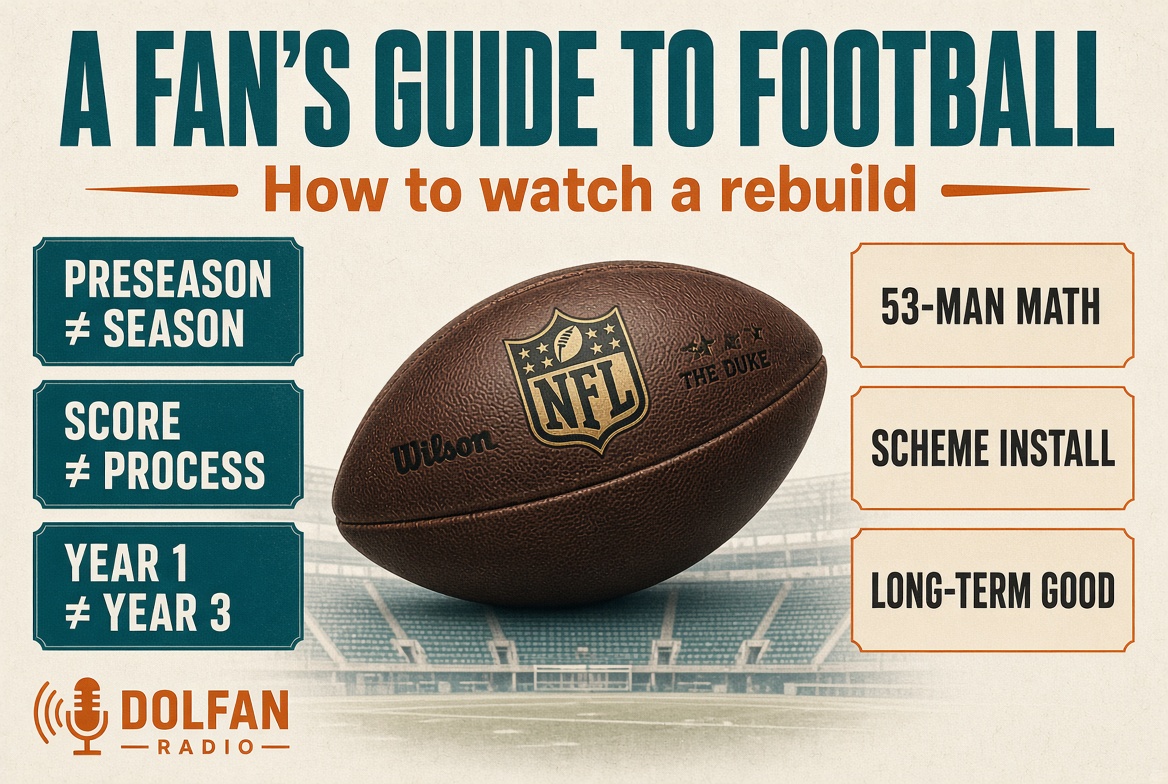
You can love this team and still not know what you are looking at. A preseason scoreboard is not a season. A 2–0 start under a new staff is not a Super Bowl window. Firing Jeff Hafley after the second exhibition is not analysis. It is a feeling with a username. Football has a calendar. This is the calendar.
I have been around this franchise long enough to hear the same sentence in five different decades: the coaches suck, the team is horrible, blow it up. Sometimes that sentence is earned. A lot of the time it is just the score talking.
This August it got loud again. Miami went 0–3 in the preseason. Most of the people who will start on September 13 in Las Vegas barely played. Three new systems are still in the install phase — Bobby Slowik on offense, Hafley on defense, a new special-teams staff. Jon-Eric Sullivan cleared the roster down to a young 53 and paid a 2028 sixth for a backup quarterback who has never taken a regular-season snap here. Hafley then said the thing fans hate most: success this year will not be measured only in wins.
People heard “we are not trying.” That is not what he said. He said there are no shortcuts, the foundation has to be real, and the tape has to show a team that flies around even when the standings do not. Then he clarified it the way every honest coach eventually does: they will try to win every game. Both things can be true. Year 1 of a rebuild is allowed to be both competitive and unfinished.
This guide is not “trust the process” as a slogan. It is how to watch football when the process is the whole point.
August games are job interviews and injury avoidance. Starters sit. The script is not the opener.
A 17–12 loss to Atlanta backups tells you almost nothing about Week 6 against a real defense.
Hafley and Sullivan are being paid to build a team that can win in January. That is not a 2026 deliverable.
Preseason football is a different sport wearing an NFL jersey. The first-team offense might get a series or two. The rest of the night is third-stringers running a reduced menu so a general manager can decide who makes the 53, who hits the practice squad, and who gets a plane ticket.
Hafley said it out loud after the Giants game: sit down, get away from the score, and evaluate the players. That is the only honest use of August tape. The Dolphins were also more scheme-heavy in practice than in games on purpose — so the kids could play fast on Saturdays and Fridays instead of thinking through a playbook they have had for a few weeks.
If your evaluation of Hafley after Game 2 of the preseason was “fire him,” you were grading the wrong test. You do not fire a teacher in week two of the syllabus because the midterm has not been given yet.
Miami did not “reload.” They stripped the roster. Tua Tagovailoa, Tyreek Hill, Jaylen Waddle, Minkah Fitzpatrick, Bradley Chubb — gone. The cap is eating an NFL-record pile of dead money this year, in the neighborhood of $180 million. Almost every veteran they added is on a one-year deal. Malik Willis is the exception, on a three-year contract, because a rebuild still needs a quarterback who can take the hits while the building learns who it is.
That is not tanking as a lifestyle. Tanking is losing on purpose and hiding it. Building is playing the people you intend to keep and finding out, in public, who belongs. Those two look identical on a scoreboard in September. They do not look the same in April.
| What you see | What it usually means | When it matters |
|---|---|---|
| 0–3 preseason | Depth chart and health management | Cutdown weekend, not the standings |
| Young 53, thin rooms | Cap wreckage plus a new staff’s first pass | Waiver wire, midseason adds, 2027 draft |
| Ugly early Sundays | Three installs colliding with a hard schedule | After 8–10 games, not after two series |
| Wins in November/December | The scheme is sticking and the kids grew up | That is the Year 1 grade that counts |
| A high 2027 pick | The cost of the reset, not the goal of it | Only useful if Sullivan hits the pick |
Sportsbooks hung this team around 4.5 wins. ESPN’s FPI had one of the league’s hardest schedules. A 4–13 year can still be a good Year 1 if the tape in December does not look like August.
The scoreboard is the last thing you should read on a rebuild team, not the first. Watch the parts that become wins later.
Pre-snap. Are they lined up right? Do they get the call in? False starts and delay-of-game in September are scheme confusion. In December they are a culture problem. Hafley already said pre-snap and post-snap penalties are selfish. Grade him on whether that sentence survives October.
The line of scrimmage. If Miami cannot run on early downs and cannot set an edge, nothing Slowik draws up will matter. Thirty-three rushing yards in an AFC title game in 1993 is still the original sin of this franchise. Physicality is not a press-conference word. It is first-and-ten after contact.
How they lose. Getting out-talented by San Francisco is not a scandal. Quitting in the fourth quarter is. Watch effort after the outcome is decided. That is the only thing a first-year staff fully controls.
Who is on the field in the fourth. If the same rookies are still in the game in December — and they look less lost — that is development. That is the product Hafley said he is selling.
A head coach in Year 1 of a teardown is not Andy Reid in Kansas City. He is a teacher with a new textbook and half a roster that was not here in March.
Grade Hafley on these, not on whether they cover 4.5:
Identity. Can you describe this team in one sentence by Thanksgiving? “We play physical and we do not beat ourselves” is an identity. “We hope Achane rips a 60-yarder” is a prayer.
The rooms that were supposed to grow. Chop Robinson in Year 3. Jacob Rodriguez taking Tyrel Dodson’s job. The receiver draft class. Malik Willis as a full-time starter. If those names are better in December than they were in camp, the staff did the job even if the standings stink.
The bottom of the 53. Sullivan said he will churn it. That is how Green Bay stays alive. The first 53 is an opening bid. Claims, practice-squad call-ups, and midseason adds are the real GM tape.
The building. Do players talk like they know the standard? Do they run to the ball? Do they own the penalties? Culture is not a mural in the locker room. It is what happens on 3rd-and-11 when the game is gone.
Fans treat cutdown day like a finished painting. It is a sketch.
| Bucket | How many | What it is for |
|---|---|---|
| Active 53 | 53 | The people who can dress. Still moves every week. |
| Game-day 48 | 48 of the 53 | Five healthy scratches. Matchup and special teams decide it. |
| Practice squad | 16 | The real development lab. Can be signed to the 53 any week. |
| IR / PUP / NFI | Varies | They do not count on the 53. Some return. Some do not. |
That is why Kenneth Grant and Trey Moore landing on injured reserve, and Storm Duck and Darrell Baker Jr. sitting on reserve/PUP, is not “the coaches have no depth.” It is the first week of a thin roster meeting a long season. Depth is built from September to December, not announced on August 30.
Three systems. New language. New calls. New landmarks. NFL players are smart and they still need reps. A defense with multiple fronts — the thing we have been writing about since July — looks sloppy until the linebackers stop thinking and start reacting. An offense built on play-action and tempo looks broken if the run game is not real yet.
Install is a sequence. First they learn the rules. Then they play fast inside those rules. Then they add wrinkles. If you judge the wrinkle phase during the rules phase, you will be wrong every time. That is most of Twitter in August.
Long-term good is not a consolation poster. It is a list.
The cap comes off the floor. Dead money is a 2026 problem. 2027 is when Sullivan can spend like a real general manager instead of taping one-year veterans onto a rookie class.
The draft capital is the inventory. A high pick only matters if the building can develop the player who arrives. That is the whole argument for giving Hafley the year. You cannot evaluate a developer if you fire him before the first class has a winter.
The standard is being rewritten on purpose. Hafley has said the outside perception is that Miami is soft, and that it eats at him. Good. The 1993 Bills game was the first public audit of that softness. Thirty-three years of coaches have said some version of “we will be physical.” The difference this time is they tore the roster down so the sentence is not being asked to cover Tyreek Hill’s speed. Speed without a line of scrimmage is how you lose in January.
The tape will tell you before the standings do. If Chop is a problem every week, if Willis can move the chains without a star receiver, if the offensive line stops the bleeding, you are watching a team that can take a real swing in 2027 and 2028. If none of that is true by December, then you have a different conversation — about the staff, not about Game 2 of the preseason.
“0–3 in the preseason means this team is historically bad.”
Look at: who played, how many starters sat, and whether the calls were a full menu or a job-interview script.
“Fire Hafley. He said wins don’t matter.”
Look at: the next sentence. He said they will try to win everything and that the foundation cannot be faked. Those are not opposites.
“They have no depth, so the coaches are clueless.”
Look at: the dead cap, the one-year veterans, and the fact that depth is a 17-week project, not a cutdown-day photograph.
“A rebuild means they are not trying.”
Look at: effort after the outcome is decided, penalties, and whether the same mistakes repeat in Week 8.
“I watched football for 20 years, I know a bad team when I see one.”
Look at: whether you are describing talent or describing a score. Talent is real. This roster is thin. That is not the same thing as “the staff has failed” in Week 0.
None of this asks you to enjoy a 4–13 year. Season-ticket money is real. Sundays are real. Booing is legal. Tua got booed in a Falcons uniform in this building last Friday and handled it like an adult. You can be sick of losing and still refuse to pretend August is January.
What this franchise has not been, for a long time, is honest about the ceiling. The 1993 piece stays in the featured slot on this site until Miami wins a game because that afternoon is still the diagnosis. The guide is the treatment plan: watch the line of scrimmage, watch the kids grow, watch whether the standard survives a losing streak.
If you want to scream that the team is horrible, wait until they have played a real opponent with a real lineup. If you want to fire the coach, wait until the scheme has had a winter. If you want to be right in two years instead of loud tonight, watch the process like it is the product — because for 2026, it is.
What are you going to grade on September 13 in Las Vegas: the final score, or the second-half tape? Leave it in the comments.